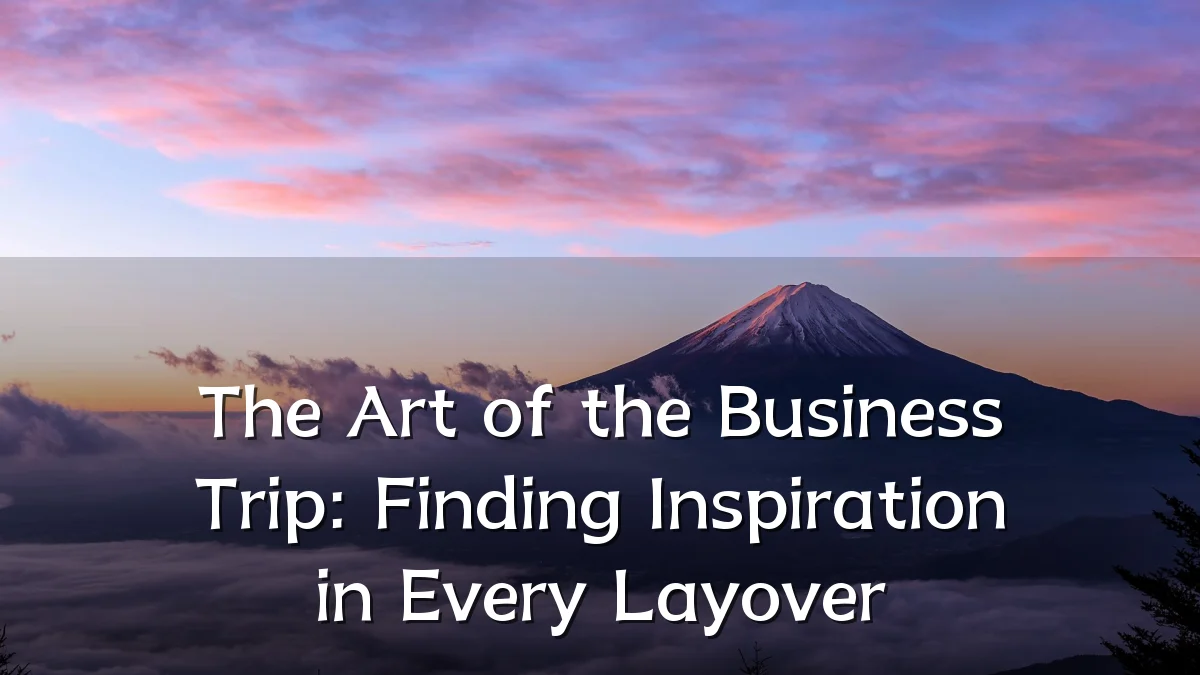
The Art of the Business Trip: Finding Inspiration in Every Layover
Recent Trends
Over the past several quarters, a noticeable shift has emerged in how business travelers approach their journeys. Rather than viewing layovers and downtime as lost productivity, many professionals now actively seek moments of professional travel inspiration within their itineraries. Travel platforms report a growing interest in "bleisure" blends — short cultural stops, curated airport lounges with local design, and guided city tours lasting as little as three hours between connections. Companies are also beginning to reimburse for a curated local experience or a coworking day pass, signaling a broader acceptance that inspiration can come from the journey itself.

- Rise of "layover city guides" offered by airlines and hotel loyalty programs.
- Increase in coworking spaces inside major transit hubs, enabling work + exploration.
- Adoption of digital detox programs during flights, followed by creative re-entry in a new city.
Background
The traditional business trip was once a tightly scheduled sequence of meetings and hotel stays, with little room for serendipity. However, the pandemic-era normalization of remote work and flexible schedules changed expectations. Professionals began questioning the value of physical travel if it meant no change in mindset. Research from behavioral economics and organizational psychology suggests that novel environments — even a few hours in an unfamiliar district or a museum — can spark creative problem-solving. This insight has gradually influenced corporate travel policies, moving from cost-per-hour efficiency to outcome-oriented travel that values the unexpected.

“A three-hour layover in a city you haven’t visited before can become a micro dose of perspective — if you let it.” — observed in a recent industry roundtable on business travel psychology.
User Concerns
Despite the enthusiasm for finding inspiration in layovers, business travelers voice several recurring concerns. Time pressure remains the top issue: a missed connecting flight or a delayed meeting can unravel any attempt at exploration. Cost accountability is another friction point — employees often wonder whether a guided walk or a museum visit is a legitimate expense. Security and logistics also play a role: leaving the airport requires extra planning, visa rules, and luggage storage. Finally, fatigue management is critical; overloading a short layover with activities can lead to burnout rather than inspiration.
- Time constraints: Tight connections (under 2–3 hours) rarely allow meaningful exploration.
- Expense ambiguity: Most companies lack clear guidelines for “inspirational” expenses.
- Security & logistics: Baggage, visa requirements, and return trip timing add complexity.
- Energy balance: Over-scheduling a layover can defeat its purpose.
Likely Impact
If current trends continue, corporate travel policies are likely to evolve to accommodate structured “inspiration time.” Early adopters of flexible travel accounts report higher employee satisfaction and retention among frequent travelers. Hotels and airports are competing to offer seamless solutions — for example, luggage transfer services linked to a three-hour city tour, or pop-up creativity workshops in transit lounges. The travel industry may see a new category: "inspiration-class" services that combine productivity tools with cultural immersion. Over the next one to three years, we can expect more companies to adopt frameworks that explicitly allocate a portion of a business trip to non-meeting exploration, as long as it ties back to professional growth or innovation.
What to Watch Next
Several developments bear watching. First, artificial intelligence travel assistants are beginning to offer personalized layover itineraries that adapt in real time to delays and energy levels. Second, airports in major hubs (such as Singapore, Dubai, and Helsinki) are experimenting with "inspiration zones" — quiet spaces for reflection, local art installations, and pop-up marketplaces. Third, sustainability metrics may influence choices: travelers may opt for longer, slower connections that allow meaningful exploration instead of short, carbon-intensive hops. Finally, the rise of digital nomad visas and hybrid work models may blur the line between business trip and personal inspiration journey even further. The key question remains whether organizations will embrace the full art of the business trip — or continue to treat layovers as mere interruptions.